


P3M Program (Education, Research, and Community Service)
The P3M Program — Education, Research, and Community Service — is the point where all curricular work finds its most authentic meaning. Its three pillars are not separate activities: education shapes one’s perspective, research tests its depth, and community service stakes it before the concrete and often messy reality of human life. Within the framework of experiential learning, P3M transforms students from consumers of knowledge into builders of knowledge — and this is where character education finds its most authentic field: not merely knowing about values, not merely feeling empathy, but acting in real situations that demand courage, sacrifice, and wholehearted presence. Thus, P3M is not an additional program — it is the curriculum itself in its most living form, the place where sophia ceases to be a text and begins to be a way of life.
Core Materials
The core philosophy of P3M is experiential learning, which regards experience as a crucial bridge connecting theoretical concepts with reality. Through this approach, students are empowered to build scientific attitudes, enhance self-confidence, and become capable of determining actions and decisions through critical reflection on their learning experiences.
Based on the stages of competency and skills provision, the materials delivered in this program include:
- SINDU and Community Empowerment
- Qualitative Research Methods
- PRA Methods (Participatory Rural Appraisal)
- Interdisciplinary Theory
- Multicultural Theory
- Initial Social Mapping
- Problem Grouping and Mapping
- Problem Identification
- Needs Analysis
- Vulnerability and Capacity Assessment
- Program Planning
- Study Simulation
- Final Report and Recommendations
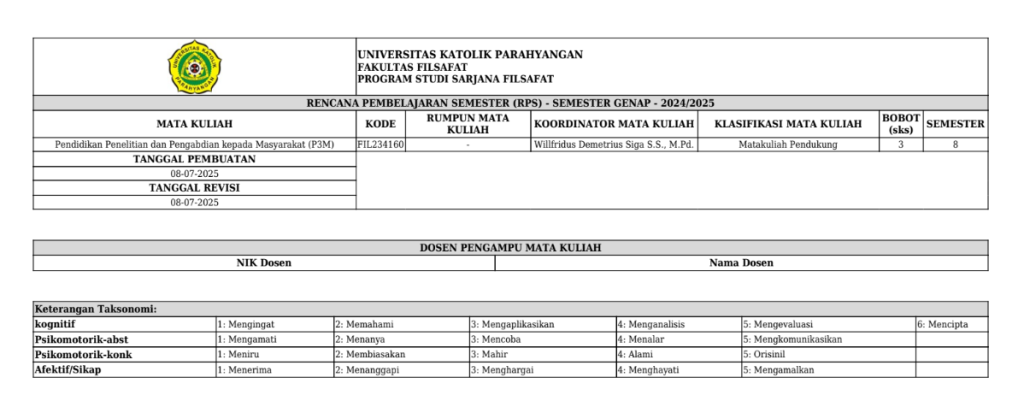
Semester Learning Plan (RPS) for P3M at the Faculty of Philosophy
This Semester Learning Plan for the Faculty of Philosophy is designed as an operational framework that integrates the Tri Dharma of Higher Education—education, research, and community service. Through a critical-reflective approach, this curriculum aligns learning, research, and service activities to sharpen the students’ philosophical reasoning. Consequently, graduates are expected not only to excel intellectually but also to possess genuine social responsibility.
Next, click the RPS image below
Publication as Intellectual Accountability
The publications produced through the P3M Program—Education, Research, and Community Service—of the Faculty of Philosophy, Parahyangan Catholic University (UNPAR) are more than mere documentation of academic activities. The P3M program guides students in constructing knowledge through the integration of research, lived experience, and meaningful action. These publications represent both the culmination of the learning process and a form of intellectual accountability. By disseminating the outcomes of education, research, and community engagement through open publication, the Faculty of Philosophy affirms that knowledge does not belong to an ivory tower. Rather, it should remain accessible to be read, critically examined, replicated, and further developed by all who are committed to the advancement of scholarship and the common good.
For further information, please click the image below.
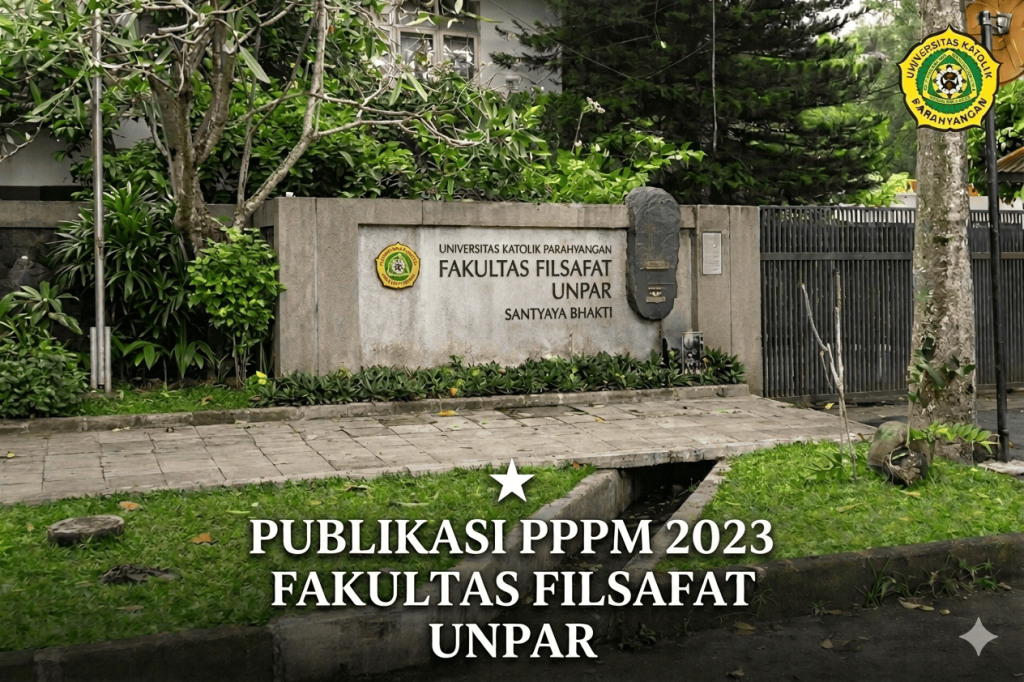
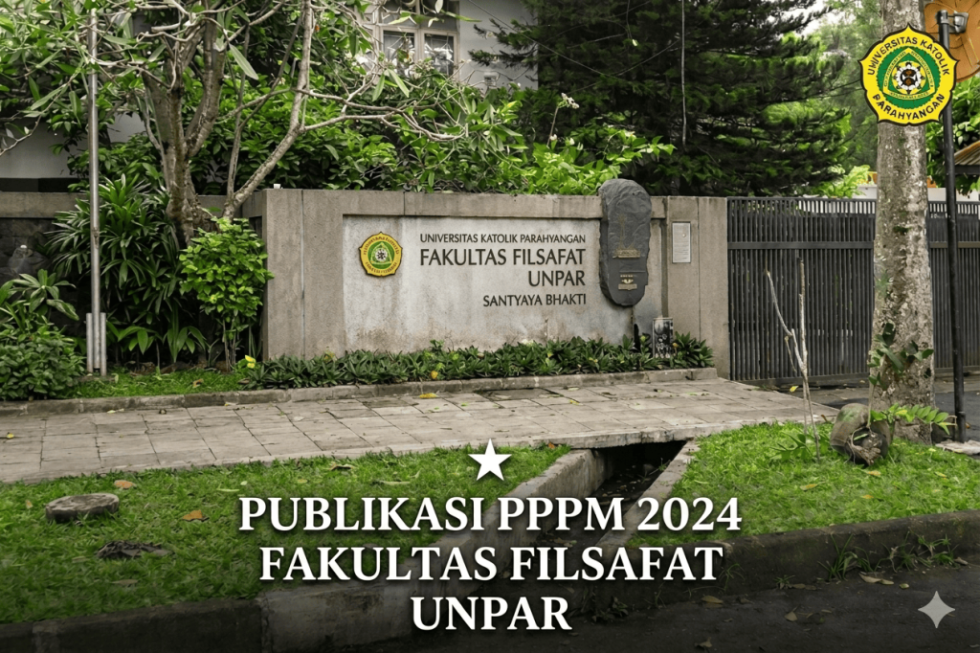
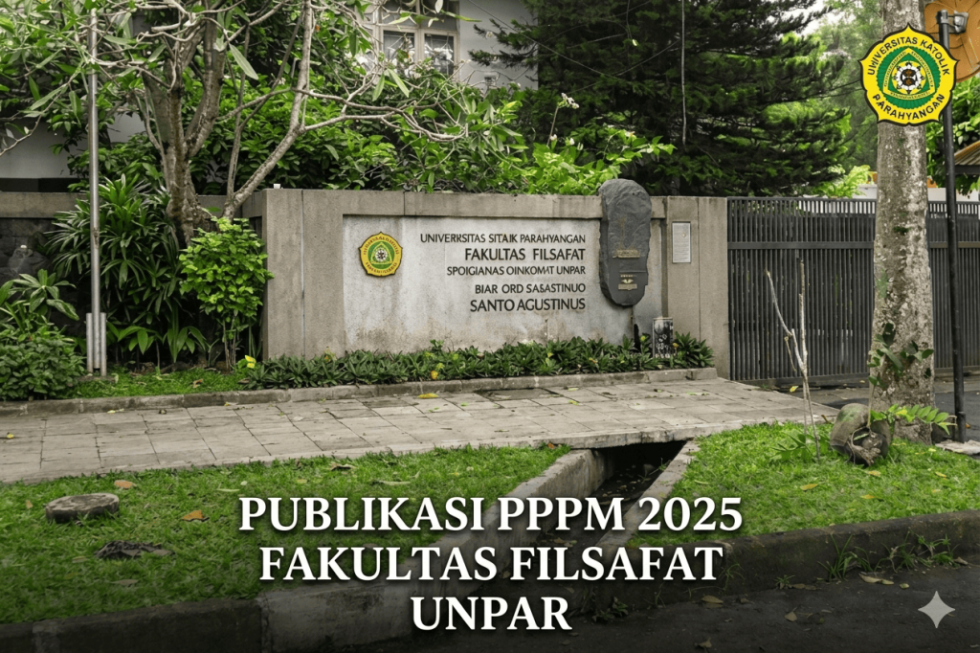
The Dynamics of the P3M Program
The P3M publications document an ongoing journey of academic engagement, demonstrating how the Faculty of Philosophy does more than reflect upon the world—it actively participates in transforming it. Through education, research, and community service, each publication captures meaningful contributions made in classrooms, research projects, and community partnerships. Together, these works illustrate the Faculty’s commitment to integrating philosophical inquiry with concrete social engagement, advancing knowledge while fostering positive change one study, one course, and one community at a time.
For further information, please click the image below.
Program Guidelines
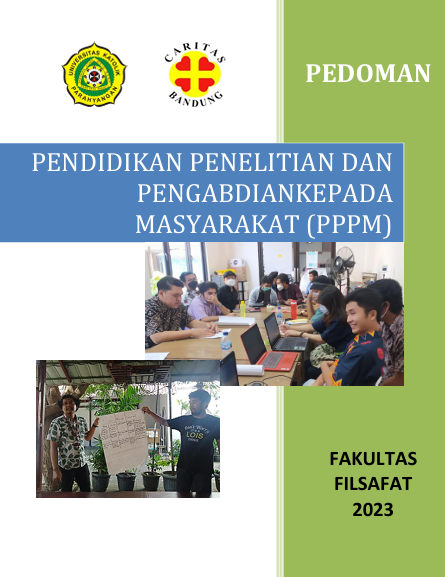
The Program Guidelines, including the P3M Pangandaran Guidelines 2023, serve as a strategic framework for implementing the three pillars of higher education—education, research, and community service—within the local context of Pangandaran Regency. Amid regional development initiatives and the growing need for cross-sector collaboration, these guidelines provide an essential reference to ensure that academic and community engagement activities align with the goals of community empowerment and village capacity building. Their implementation reflects the Faculty’s commitment to accountable, transparent, and impact-oriented academic governance.
The significance of these guidelines lies in their role as an operational framework that integrates academic principles with practical field implementation. By providing a clear and systematic reference, the guidelines enable lecturers, researchers, students, and community partners to design, implement, monitor, and evaluate P3M programs in a consistent and sustainable manner. More than a procedural manual, this document embodies the University’s commitment to fostering meaningful partnerships with communities and promoting socially just and sustainable development.
For further information, please click the image below.
Collection of P3M Program Outputs
The outcomes of the P3M Program at Parahyangan Catholic University are presented in diverse and well-organized formats. These outputs include popular articles, scholarly publications, documentary videos, and reports with policy recommendations. Each output is available in digital format to facilitate public access and broader dissemination of knowledge generated through education, research, and community engagement.
- Popular Articles
- Scholarly Articles
- Documentary Videos
- Reports and Recommendations
The P3M Program demonstrates that meaningful education is rooted in lived experience. Education develops knowledge. Research examines its validity. Community service translates knowledge into social responsibility. Together, these interconnected processes cultivate students’ cognitive, affective, and practical competencies. Through P3M, the Faculty of Philosophy at Parahyangan Catholic University affirms that philosophy does not end with reflection alone but is realized as a living praxis that contributes meaningfully to society.
— ICS (Yusuf S.)